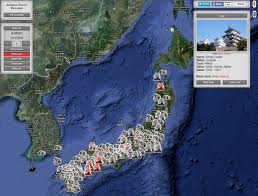
 map showing locations of castles. greyish lumps are castles. |
 |
|
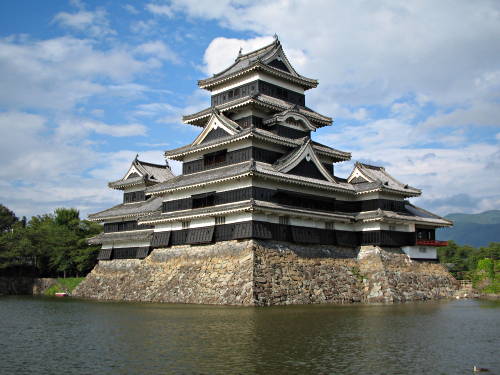
The need for castles arouse during the late 15th century, after the central government's authority had weakened and Japan had fallen into the 'Chaotic Era of Warring States' (sengoku jidai). During that era, Japan consisted of dozens of small independent states that were fighting each other and castles began to be built for defensive purposes. Originally Japanese castles were 'fortresses' and their main purpose was being military defence. The castles were positioned in locations that would give an advantage against attacks and also trade routs, roads and rivers. Later, they became home to daimyo (feudal lords). The first fortifications were made primarily of earthworks and wood and made great use of natural defences and topography. These were never intended to be long-term defensive positions and were buit when needed and abandoned afterwards. Most castles were called 'yamashiro' or 'mountain castles' because they were built from the mountains rather than on top of hills or mountains. Trees and plants were cleared and the dirt and stone was carved and transformed to make the castle. To provide further protection against attacks, ditches were dug as obsticles and moats were later created. When Oda Nobanaga re-established a central authority over Japan (around a century later) and his successor Toyotomi Hideyoshi completed the reunification of Japan, many larger castles were built across the country. Unlike the original castles, they were built in the plains or on small hills, where they served as a region's administrative and military headquarters. They became the centers of 'castle towns'. During the Meiji Period (represents first half of the 'Empire of Japan), many castles were destroyed as unwelcome relics of the feudal past and even more were lost during World War Two. Only about a dozen original castles (castles constructed before 1868) survive today. Several other castles were reconstructed over the past decades and have been used as museums and tourist attractions.
|
||
